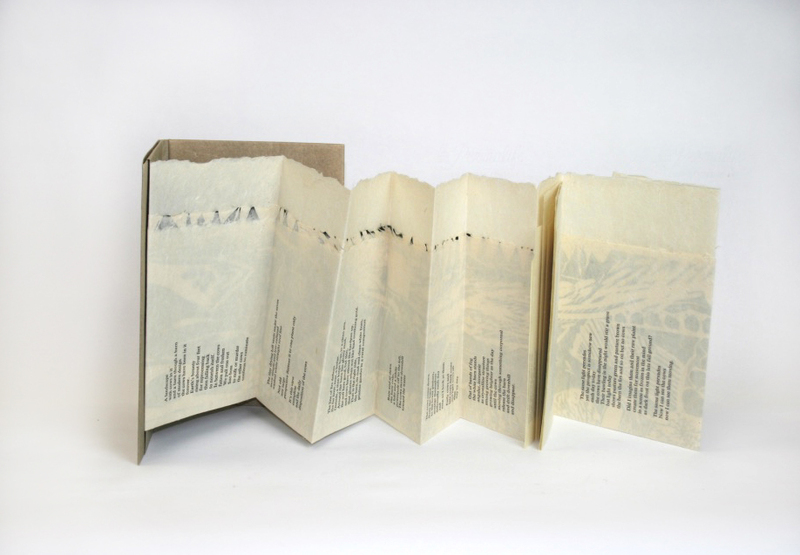
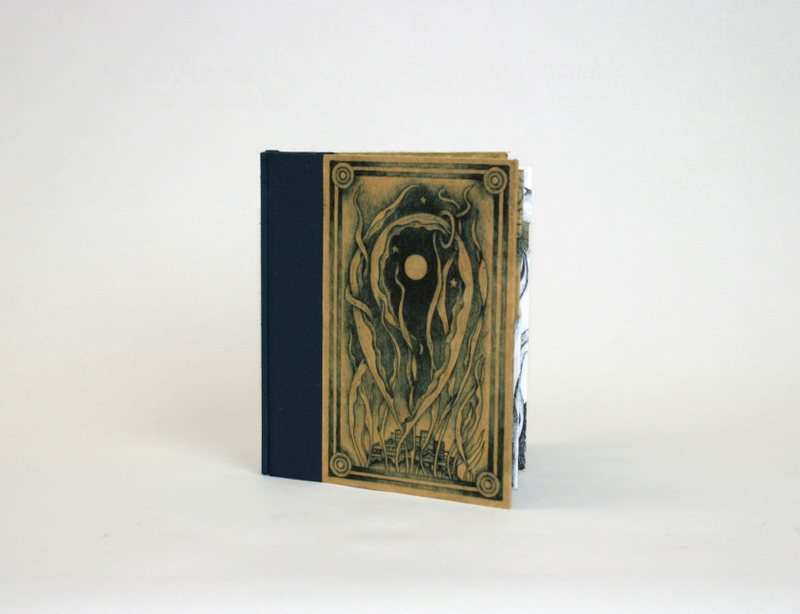
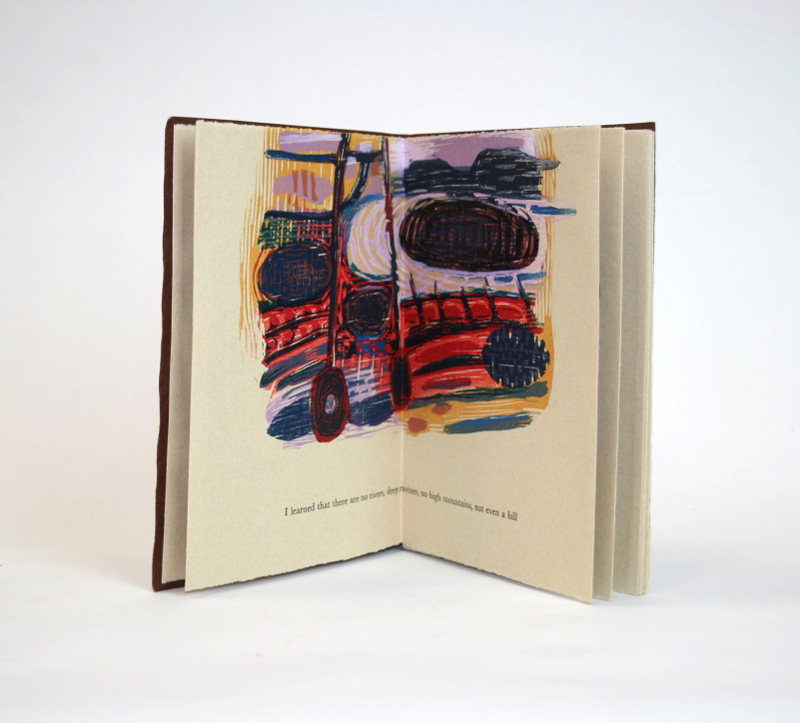
Accordion fold, printed on one side to form ten pages. To the sheet are attached eleven leaves with the remaining text, also a folded leaf of plates in pocket behind the text. Linoleum cut by Ruth E. Fine. Edition of 150.
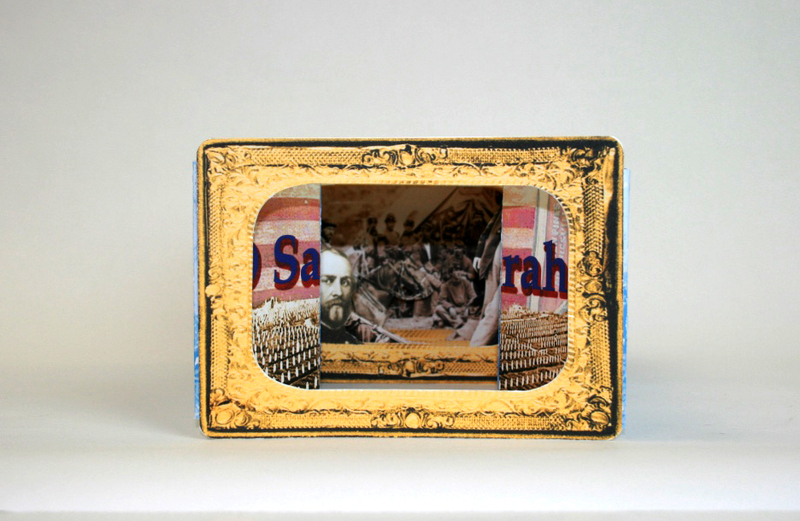
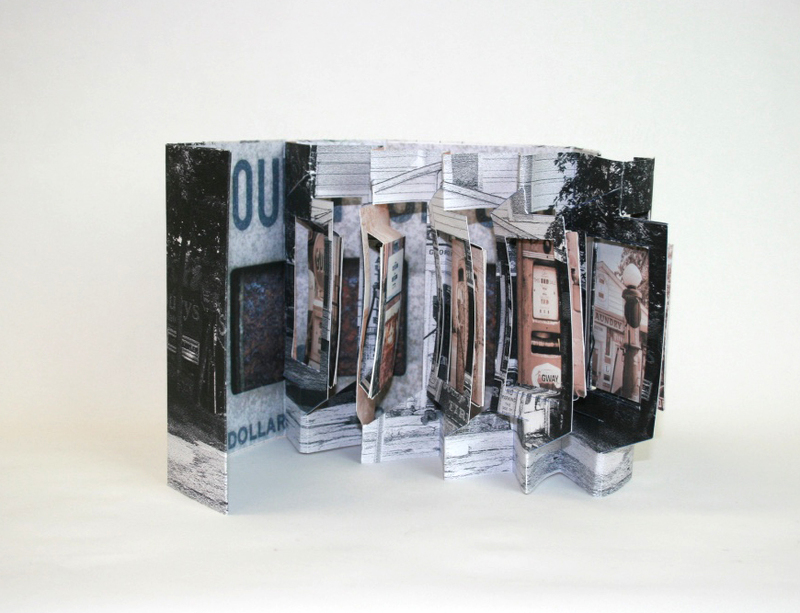
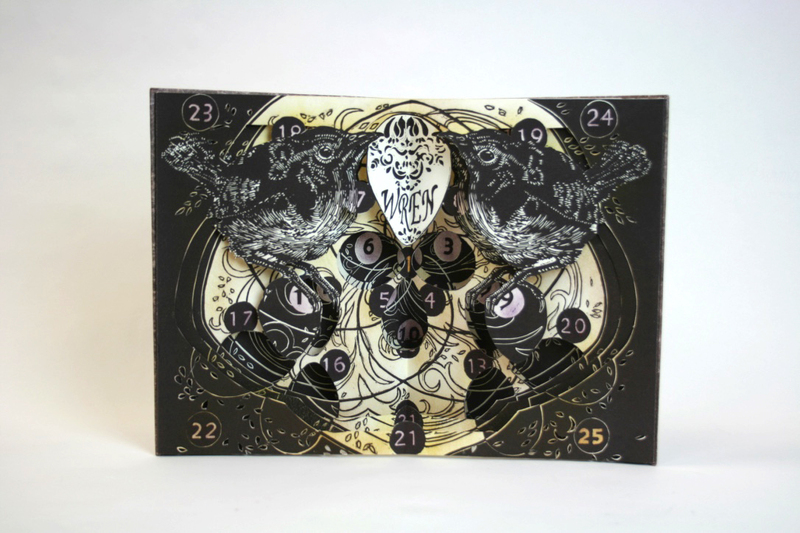
A dioramic art work consisting of six interconnected frames with openings through which illustrations can be viewed when the frames are separated accordion-fashion
Issued in a plastic box.
Edition of 600
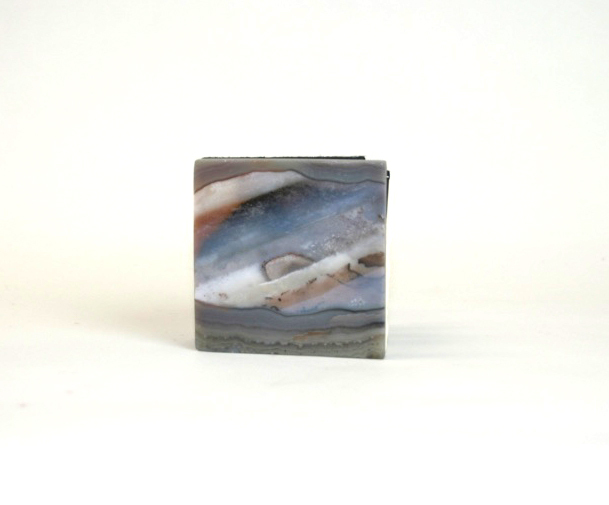
This artist's' book contains a collection of actual postage stamps from around the world that picture rocks and minerals. The structure of the book has three sections that unfold from an accordion spine. The font is Berliner Grotesk. The front cover is made from a rock that has been cut, ground and polished by the author. Each book in this edition of 50 has a different cover. No. 18 of 50.
Fifteen poems by Robert Bly and fifteen pieces of visual interpretations by various book artists and printmakers. Artwork by Bonnie Thompson Norman et al.
Accordion fold with double detachable spines
Edition of 12
“The artist grew up in a small Kansas town and now resides in Chicago. Her work explores the relationship of the human being to familiar, domestic objects and lost sheltering spaces. Sheltered in Middle America is the artist’s response to climate change, The original graphite drawings were drafted on Midwestern highways.”
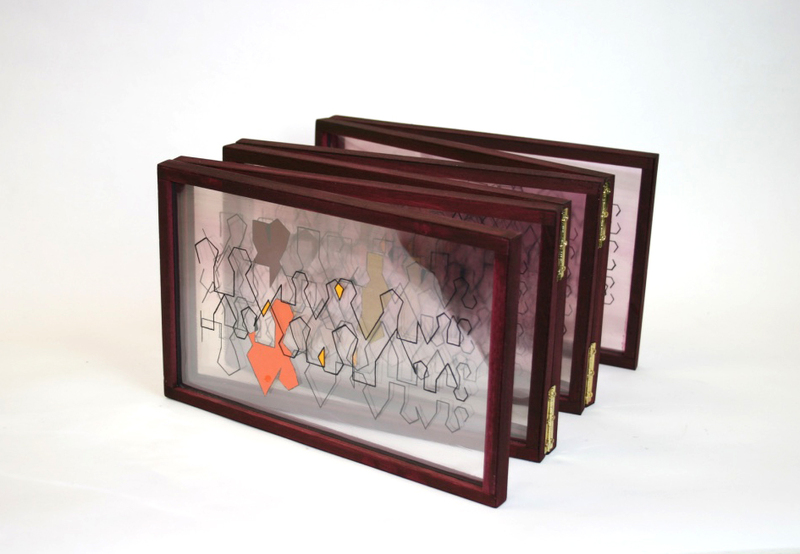
Six hinged triple-pane panels, accordion structure. Wood frames with enamel and ink on Mylar.
“Within a framework of hinged panels, Number Box constructs a series of lines made of polygons arranged on six triple-pane transparent screens. The polygons were derived from a grid of numbers that changed order on every line. The scale of each set of four polygons, four sets per line, was determined by applying a simple formula to each set of numbers.”
”But, O Sarah! If the dead can come back to this earth and flit unseen around those they loved, I shall always be near you; in the garish day and in the darkest night -- amidst your happiest scenes and gloomiest hours -- always, always; and if there be a soft breeze upon your cheek, it shall be my breath; or the cool air fans your throbbing temple, it shall be my spirit passing by. Sarah, do not mourn me dead; think I am gone and wait for thee, for we shall meet again…" July 14, 1861, Sullivan Ballou
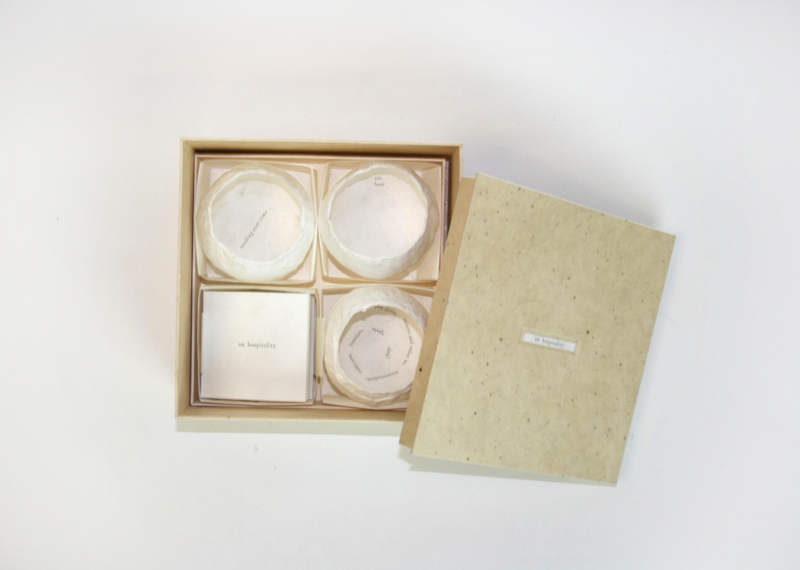
Hand-built protective box with removable lid for three bowls and a book
“3 hand-formed bowls made of cotton and abaca mix, carry embedded letterpress-printed text with companion accordion book nestled in four origami boxes. “...they are as light as hummingbirds, but surprisingly durable and strong. They are meant to be held.”
Poem by Lenora Castillo, woodcuts by Karen Kunc
"This edition of 125 copies was created for and supported by the Library Fellows of the National Museum of Women in the Arts, Washington, D.C."
Thirty sections with three folios. Mould-made Johannot paper. Colored and laser-engraved edges. Bound in laser-etched plexi glass. Two needle Coptic sewing and Coptic end bands with linen thread. Presented in a folding box with gilded wooden cube and magnetic closure.
Edition of 30
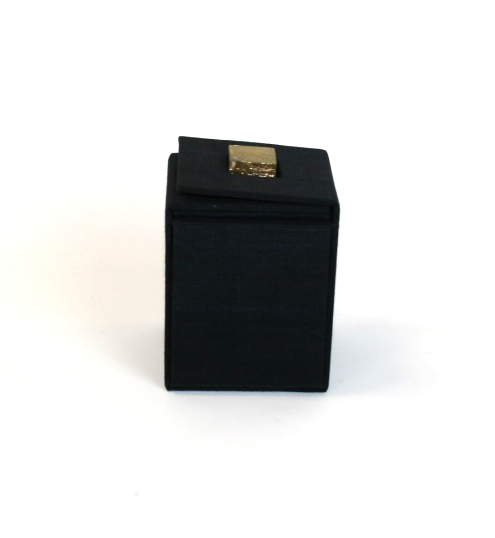
"This book is inspired by The Kaaba, a cuboid building at the center of Islam's most sacred mosque, in Mecca, Saudi Arabia. It is the most sacred point within this most sacred mosque, making it the most sacred location in Islam. Wherever they are in the world, Muslims are expected to face the Kaaba when performing prayers. In addition one of the Five Pillars of Islam, every Muslim is required to perform the hajj pilgrimage at least once in his or her lifetime, if one is able. Multiple parts of the hajj require pilgrims to make circumambulation seven times around the Kaaba. A tiny black cube is positioned at the center of the inner back board, around which are concentric circles cut in the thirty sections of the book to reflect the process of circumambulation."
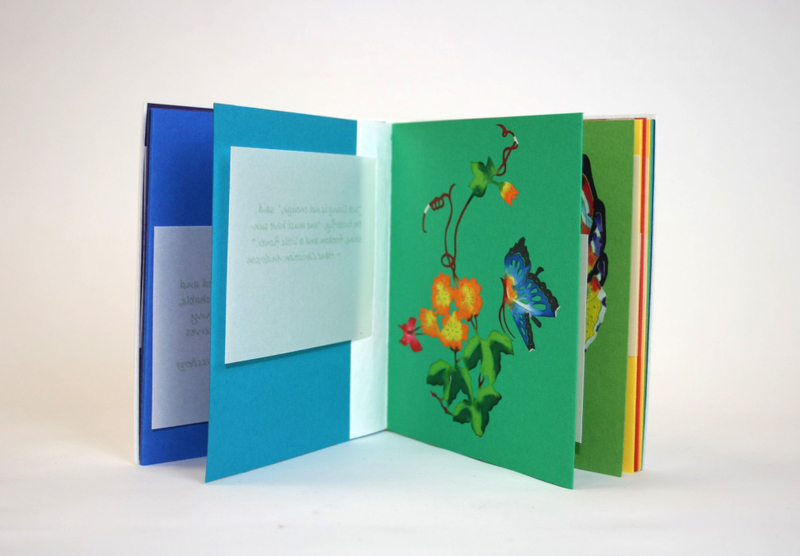
Concertina binding, issued in a split-page format: each page consists of three pieces of paper attached to a central accordion-folded hinge
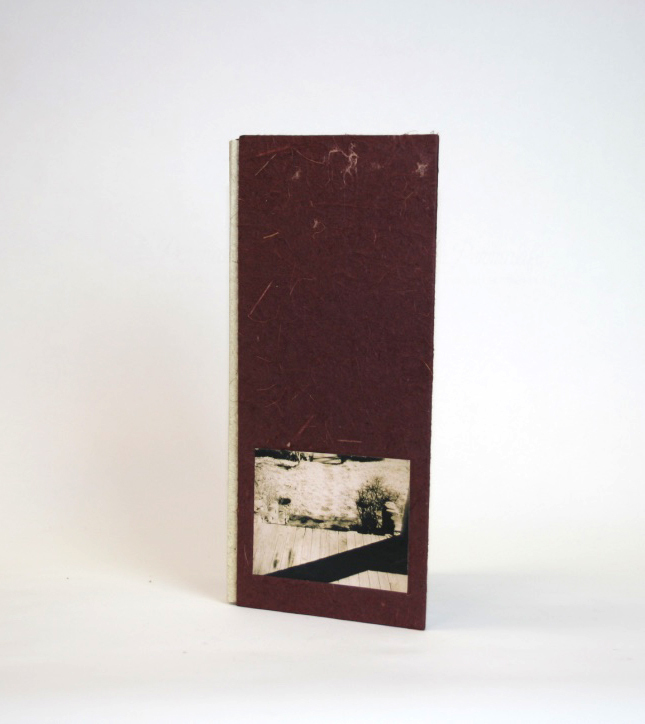
"The porch photographs in this limited edition book are color xeroxes of infrared silver prints shot in Penland, N.C. ... Photographs, printing, book design and binding by Jean Buescher. Printed at the Digger Pine Press in Berkeley, CA."
"These are paper cuts, made from rice paper and hand cut by Chinese folk artists, are mounted on color paper. The font is Bradley hand printed by Giclee on UV ultra paper. Cover is a deboss, accordion spine is made from Tyvek.
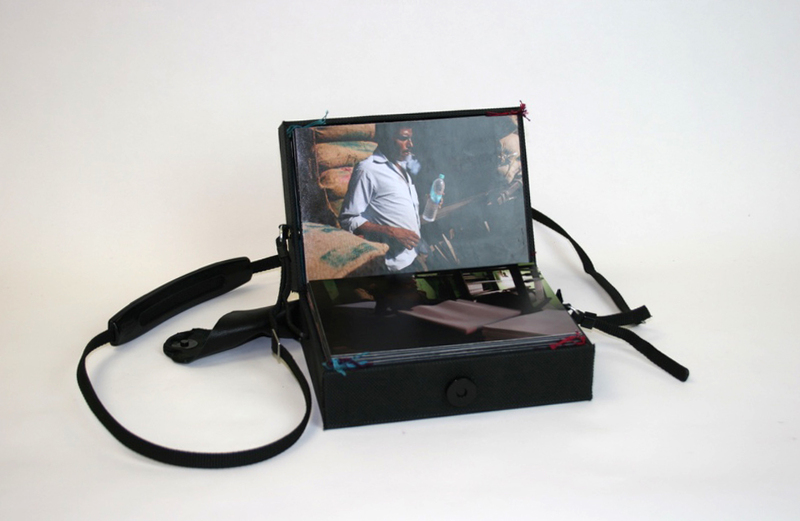
Case made with binders boards, a photographic filter, book cloth, leather, camera strap and magnetic closure.
Edition of 30
The book’s viewing sequence and binding structure are based on the photographer’s trail through the alleys of Old Delhi. Photo panels unfold left, right or sometimes in both directions. Rather than a photo album, the book is made to look like a stack of loose prints or a pile of raw experiences.
Illustrated by the author with Japanese characters and original color etchings. Hinged and folded to be read as a conventional book or as a three-dimensional book-sculpture.
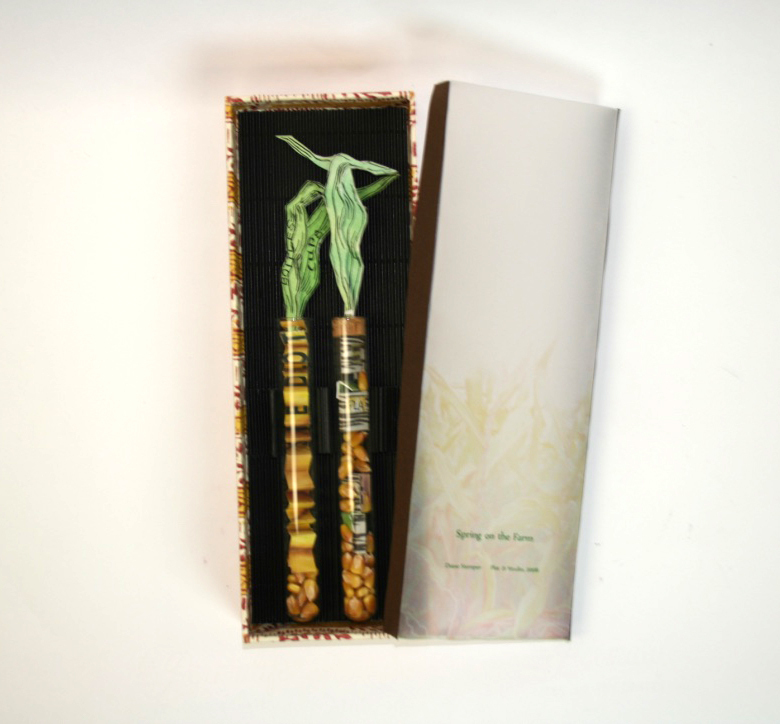
Watercolor, pen and ink, corn seeds and relief and archival inkjet prints. Test tubes are housed in a box.
Part of a larger series on corn and agriculture. The book is comprised of smaller miniature books inside of two test tubes.
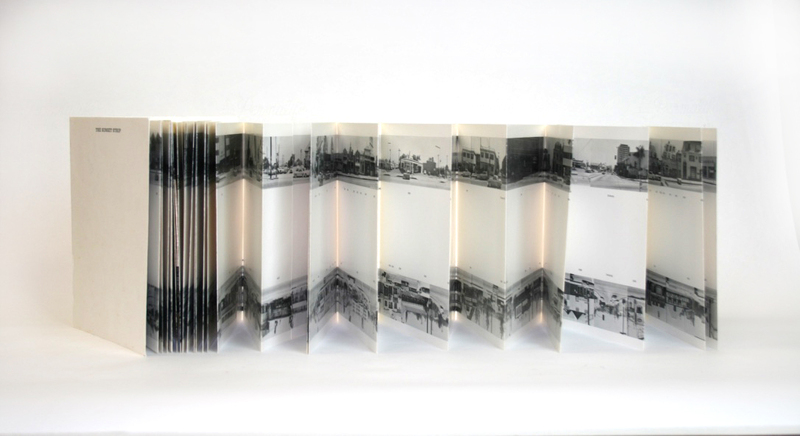
Strip of continuous paper that extends to 27 feet showing both sides of the street, with buildings, intersections, and signs viewed as if driving down the street.
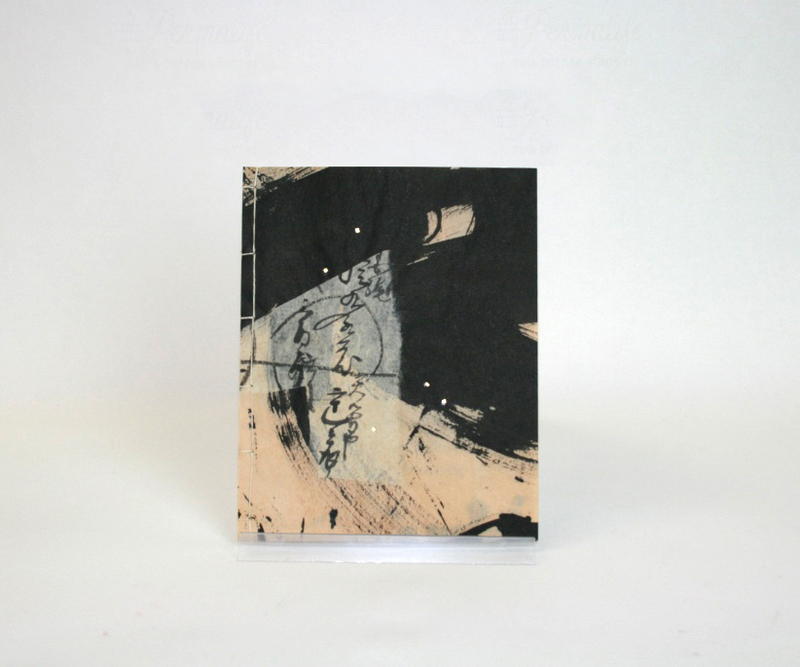
Poem by David Annwn, Calligraphy by Thomas Ingmire.
“2015 marks the 130th anniversary of Ezra Pound’s birth and the 100th anniversary of his beginning to write The Cantos. David Annwn, with his poem ‘Going Up to Sun Terrace,’ pays tribute to these anniversaries and to the influence Pound has had on his own work. The book also includes Pound’s ‘The River Merchant’s Wife, a letter’ and Li Po’s ‘Shangyangtai.’” -Thomas Ingmire
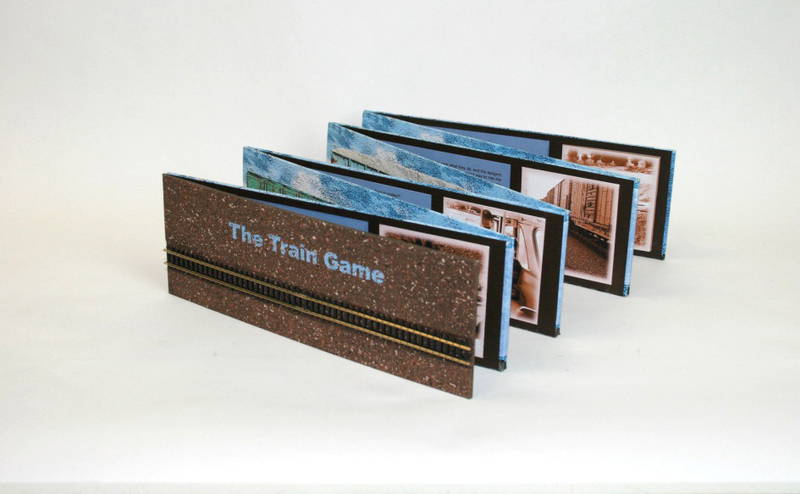
Accordion folded panels. All photographic images are giclée printed on Hahnemühle linen, the text is printed on Fox River Confetti, the font is Arial, and the panels are hinged with acrylic stained Tyvek. A model train track is embedded on the front cover.
"The train game is a true story of two adventurous friends who thought riding the rails would make for a good story for their college literary magazine. This was way back in 1968 when they were young and naive."
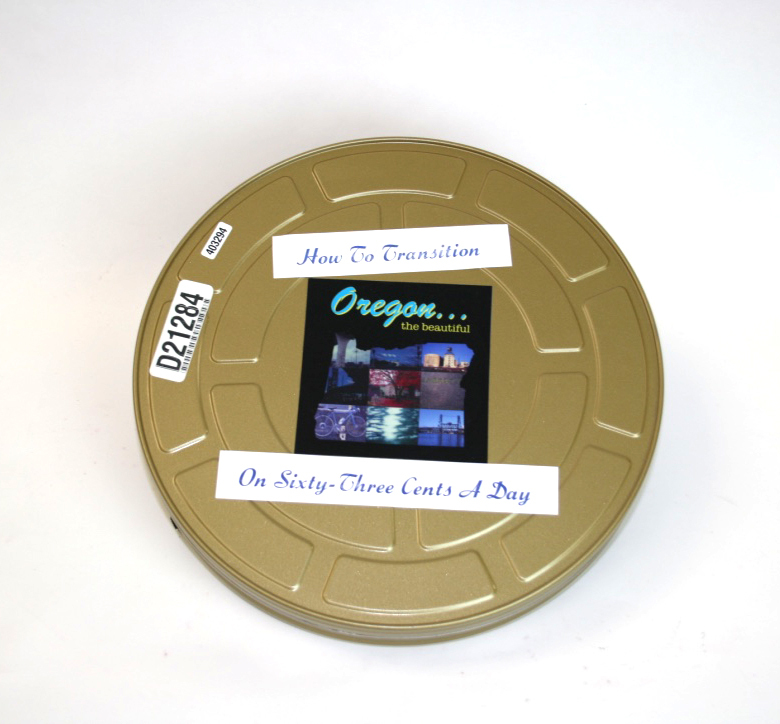
"This book is dedicated to all the people, places, and institutions who helped me transition at such little cost."--Colophon
Written in a series of brief letters on postcards addressed to the author's mother, Krist writes about living out on the Pacific Coast while transitioning from female to male
Lama Li, Strathmore and Epson digital papers.
No. 5 of 15
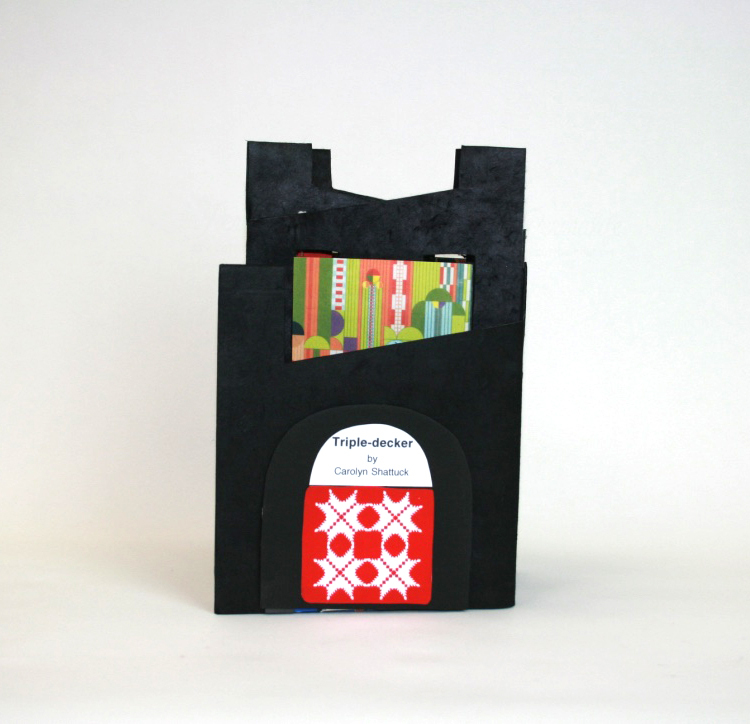
"The interweaving accordion book represents Triple-decker houses which were built in the United States to accommodate newly arrived immigrant workers and their families. The apartments are decorated with textiles, fabrics and tiles that are visually intermingled with those of other ethnic families signally a wide range of diversity. Like the flags displayed at the U.N., this represents a melting pot of ideas and tolerance for coexistence."
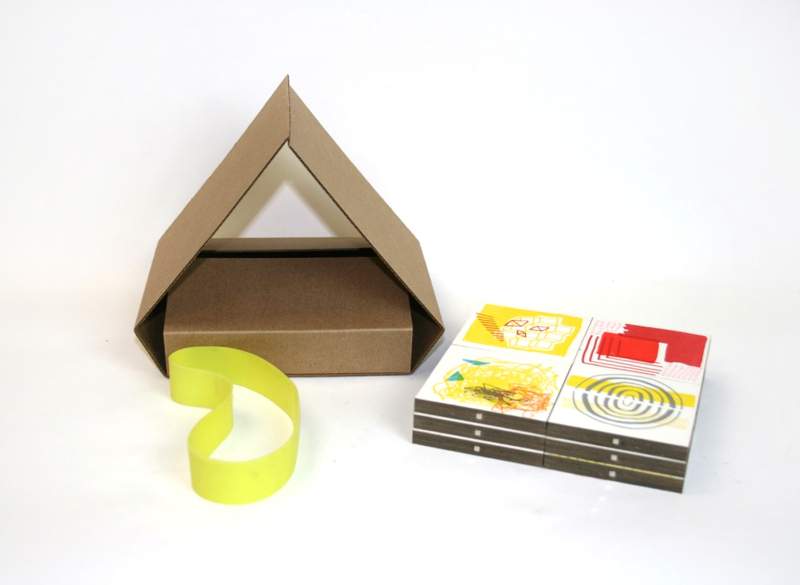
“This modular piece features a collection of 12 letterpress prints adhered to magnetic blocks. VVVVV allows the viewer to rearrange the images/prints to form new artworks.” Edition of 200.
Edition of 45
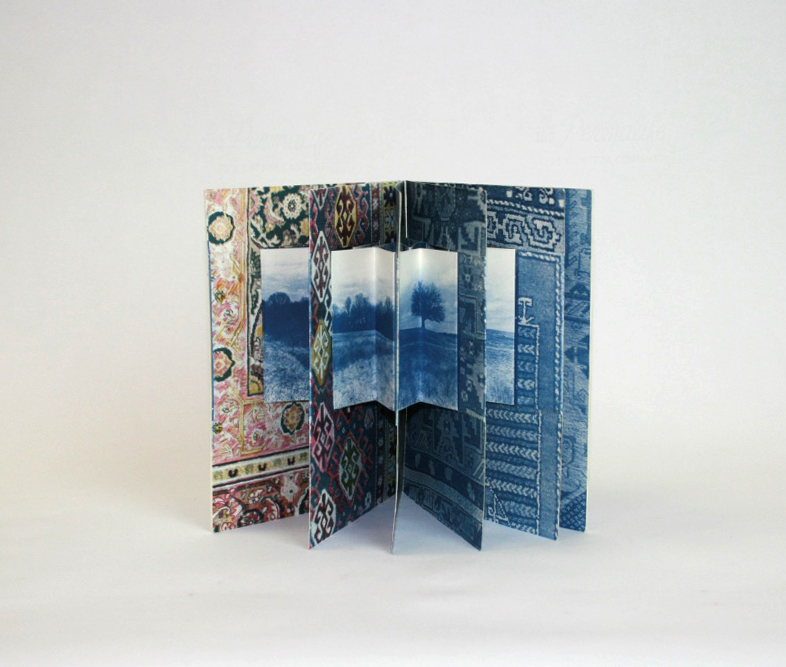
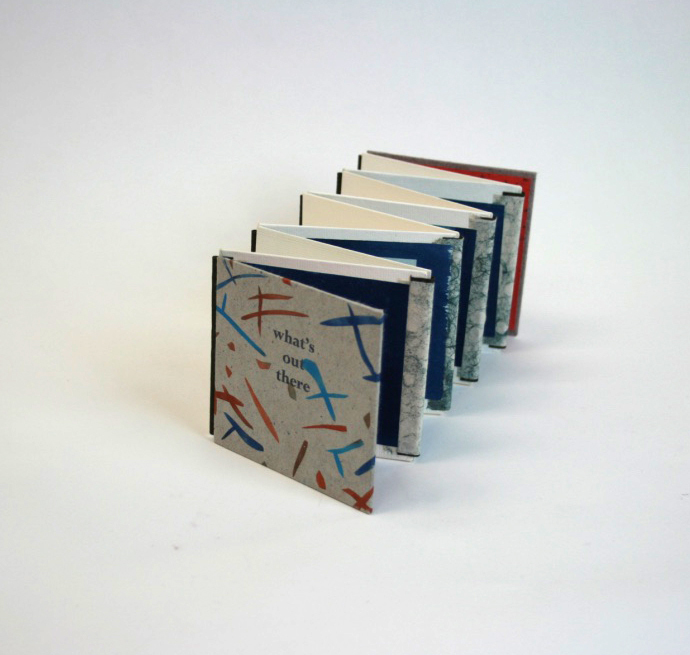
Letterpress printed at Pyramid Atlantic from handset type by Jean Buescher. Images are cyanotypes by Tom Finke. Accordion binding by the author with cloth and paper hinges has text on one side and images on the other. Cover has printed title on Pochoired paper
Hand cut relief prints with pochoir color and gold leaf accents. Printed on Arches Cover paper. Bound in hand-dyed Tyvek hard covers.
No.2 of 2
“I’m an instructor who believes in working alongside students, and many of the projects assigned for the students developed into larger projects for myself. XX is an example of how working with my students and being in foreign location can create inspiration. There is beauty in charts, graphs, and other visual detritus that accumulates. My goal is for this informational detritus to take on new roles based on contexts and juxtaposition.”